How a Peptide Pen Works
A peptide pen holds a cartridge of liquid and uses a dial to set a volume. This page describes the device, the two ways researchers get a pen ready, and the arithmetic behind its setting.
The dial on a pen sets a volume of liquid, not milligrams of peptide. The strength of the liquid decides what each setting represents. Some pens arrive pre-filled. Others are filled by the researcher from a mixed vial, and researchers commonly use 3 mL of bacteriostatic water for that.
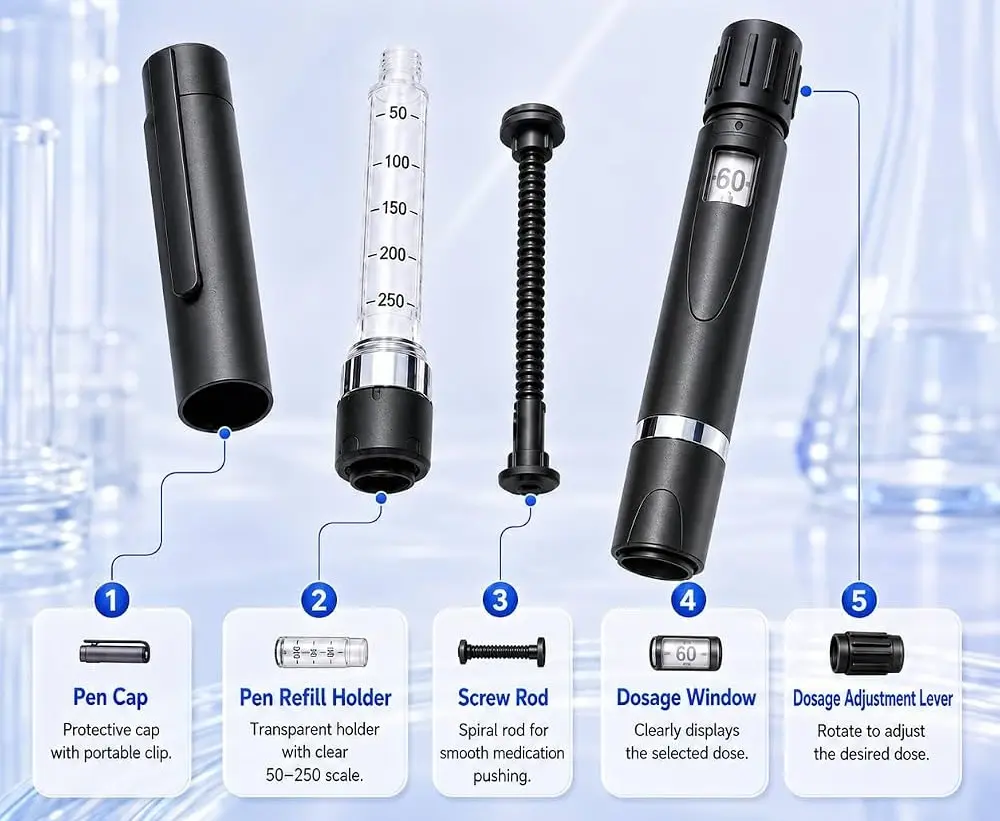
The Parts
- Pen cap. A protective cap, usually with a clip.
- Refill holder. A clear holder with a printed scale. It holds the liquid.
- Screw rod. A spiral rod that moves the plunger as the dial turns.
- Setting window. Shows the number the dial is set to.
- Adjustment dial. Turning it changes the setting.
A cartridge pen works the same way, with a sealed cartridge in place of the refill holder. Both use a sterile pen needle in a sealed cap.
Which Route Is Yours?
Pens reach researchers in two ways. Open the one that matches yours.
A My Pen Came Pre-FilledThe liquid is already inside
Nothing needs mixing. The strength is printed on the pen or its packaging, usually as mg per mL or mg per cartridge. That printed figure is the one the arithmetic below uses.
If the strength is not printed, the supplier or maker has it. Researchers commonly do not guess it. Common practice
B I Fill It Myself From a VialThe powder is mixed first
Mix the Vial
Mix the vial with bacteriostatic water. Researchers commonly use 3 mL for a pen. Common practice
Work Out the Strength
Enter the vial mass and the water volume in the calculator. The strength line (mg per mL) is the number the pen setting depends on.
Fill the Refill Holder
Transfer the mixed liquid into the refill holder with a sterile syringe, up to the mark on its printed scale. The maker's leaflet gives the loading method for that pen.
Label It
Write the strength and the date mixed on the holder or the pen. Common practice
Why the Strength Matters
The dial is marked in units or millilitres. Both are volumes. To know how much peptide a setting represents, the strength of the liquid is needed: the printed figure on a pre-filled pen, or the calculated one for a pen filled from a vial.
Before setting the dial, researchers commonly check three things: the strength written on the cartridge or the vial label, the strength the calculation assumed, and the volume left in the cartridge. If the three do not agree, they stop and re-check. Common practice
Setting the Pen
Check the Strength
Compare the label, the calculation and the volume left in the cartridge.
Clean the Seal
Wipe the rubber seal on the pen with an alcohol wipe and let it dry.
Fit the Needle
Remove the outer cap, seat the needle on the pen, then twist to secure it.
Set the Dial
Turn the dial until the window shows the volume calculated. The dial clicks at each step.
Follow the Leaflet
Delivery follows the instruction leaflet that came with the pen. This site describes the device and the arithmetic only.
Remove the Needle
Replace the needle cover, unscrew the needle and put it in a sharps container. Return the pen to cold storage.
Example: A Researcher Setting Up a Pen
This video shows how a pen is commonly set up and used. Common practice
Third-party video: How to Use Your Peptide Pen: Step-by-Step Guide on YouTube. Where it differs from the maker's instruction leaflet, the leaflet wins.
Points of Note
- Researchers commonly check the window for the liquid remaining before each use. Common practice
- A new needle for each use is common practice. Common practice
- If the dial will not turn or the cartridge looks empty, stop and ask the maker or supplier.